Abstract
In the wake of environmental degradation and unsustainable agricultural practices, Rwanda has emerged as a continental leader in environmental reform. This paper critically evaluates Rwanda’s environmental policy reforms and their tangible impacts on sustainable land management.
1. Introduction
Rwanda’s environment is both its greatest asset and its greatest vulnerability. Environmental reform in the country is driven by the need to safeguard its natural capital while ensuring economic growth and food security for its population.
2. Methodology
This study uses a mixed-methods approach, including policy review, GIS and remote sensing analysis, and local case studies to assess the impacts of reforms across different ecological zones in Rwanda.
3. Historical Context of Land Use in Rwanda
Pre-colonial Rwanda featured communal land use, but colonial policies introduced fixed tenure. Post-genocide efforts emphasized land registration and regulation, setting the foundation for environmental planning reforms.
4. Key Environmental Policy Reforms
4.1 Green Growth and Climate Resilience Strategy (GGCRS)
Launched in 2011, GGCRS outlined a low-carbon development pathway integrating climate resilience into national planning and emphasizing ecosystem services.
4.2 National Land Use and Development Master Plan (NLUDMP)
This plan provides zoning for agriculture, conservation, and urban development, supporting balanced land use aligned with population and environmental needs.
4.3 Vision 2050
Rwanda’s Vision 2050 focuses on sustainable development and green urbanization. Environmental integrity is a core principle to achieve inclusive, long-term growth.
5. Impact on Sustainable Land Management
5.1 Terracing and Soil Conservation
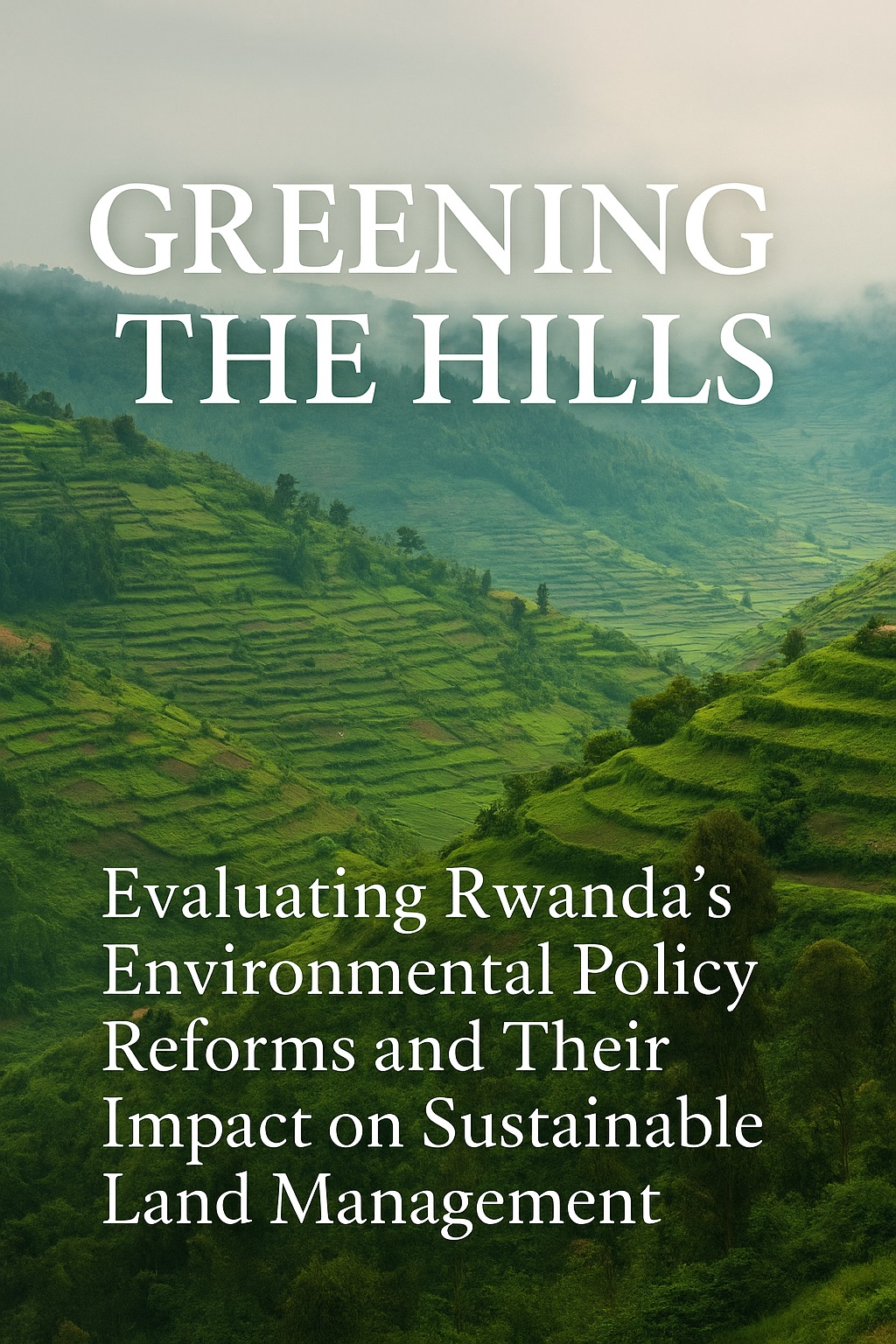
Terracing has expanded in highland districts, reducing soil erosion, increasing agricultural productivity, and improving water retention.
5.2 Reforestation and Agroforestry
Forest cover increased to over 30% by 2021 (FAO, 2021). Agroforestry integrates tree planting with crops, contributing to biodiversity and carbon sequestration.
5.3 Watershed and Wetland Protection
Projects like the restoration of Rugezi and Nyandungu wetlands have improved biodiversity, reduced flooding, and created recreational green spaces.
6. Case Study: Nyabihu District
The Integrated Land and Water Management (ILWM) approach in Nyabihu transformed degraded land into fertile fields and introduced community-led conservation initiatives.
7. Challenges and Unintended Consequences
- Land pressure due to population density
- Inequities in land access and titling
- Climate variability testing system resilience
8. Discussion
Rwanda’s reforms demonstrate strong political will and innovation, but sustaining impact requires adaptive governance, participatory planning, and regional cooperation on climate issues.
9. Policy Recommendations
- Strengthen land governance and transparency
- Scale up nature-based and ecosystem approaches
- Integrate climate forecasting tools into land planning
- Enhance stakeholder participation at all levels
10. Conclusion
Rwanda’s reforms have made measurable progress in restoring degraded landscapes and building resilience. The nation’s environmental model offers valuable lessons for other developing countries facing land degradation and climate risks.
References
Daley, E., & Englert, B. (2010). Securing Land Rights for Women. Journal of Eastern African Studies, 4(1), 91–113.
https://doi.org/10.1080/17531050903556675
FAO. (2021). Global Forest Resources Assessment: Rwanda.
https://doi.org/10.4060/cb7432en
Government of Rwanda. (2011). Green Growth and Climate Resilience Strategy.
Link
Haregeweyn, N., et al. (2015). Soil Erosion and Conservation in Rwanda. Natural Hazards, 77(1), 337–363.
https://doi.org/10.1007/s11069-015-1596-1
Musahara, H., & Huggins, C. (2005). In C. Huggins & J. Clover (Eds.), From the Ground Up. ISS/ACTS.