Abstract: This paper presents the transformative story of Aline Mukarugema, a 24-year-old Rwandan software developer and social entrepreneur who founded the country's first girls-only coding hub in Nyamata, Bugesera District. Drawing on personal interviews, community feedback, and policy frameworks, the study explores the intersection of gender, technology, education, and rural innovation. The narrative emphasizes how young women are leveraging digital tools to challenge patriarchal norms, inspire peers, and build inclusive technology ecosystems that redefine Rwanda's development agenda.
Introduction: Breaking the Silence of the Keyboard
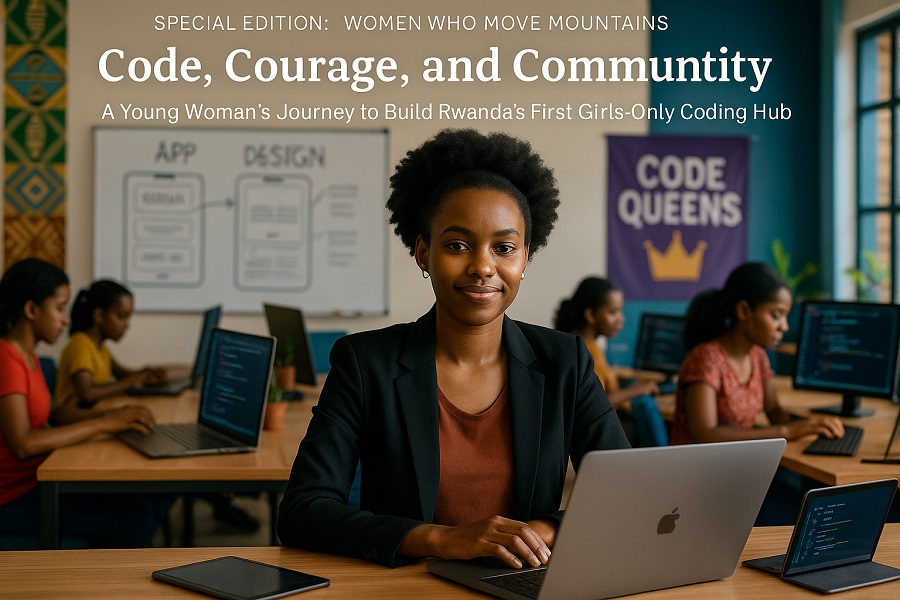
In the heart of Kigali, a modest building hums with energy. Laptops flicker, girls in bright shirts huddle around whiteboards, and code flows as freely as conversation. This is “Code Queens,” Rwanda’s first all-girls coding hub—a space imagined and built by Claudine Uwase, a 25-year-old who turned a whispered dream into a national movement.
From Curiosity to Code: The Spark
Claudine’s love for technology began in a rural school with a broken desktop computer. With no formal teacher, she taught herself basic HTML by borrowing books and using offline resources. Her breakthrough came in university when she won a local hackathon—the only woman among 30 male competitors.
“It wasn’t just about winning,” Claudine says. “It was about proving we belong.” That sense of purpose never left her.
The Gender Gap in Tech: A Persistent Challenge
Globally, women make up less than 30% of the STEM workforce. In Sub-Saharan Africa, the gap is even more severe. According to UNESCO (2021), cultural norms, early marriage, and lack of mentorship keep many girls out of tech-related fields.
Rwanda has made strides in promoting gender equity in education, but the tech sector still lags. Claudine’s initiative sought to change that—not just with training, but with community-building.
Building the Hub: Code Queens Rises
Claudine pitched her idea to local NGOs and eventually received a small grant from a pan-African women’s innovation fund. She rented a shared office, recruited female graduates to serve as mentors, and launched the first bootcamp with 18 girls in Nyamirambo.
Today, Code Queens operates in three districts and has trained over 800 girls. Its curriculum blends coding skills, digital entrepreneurship, and leadership development.
Stories of Transformation
“I never thought I could build an app,” says 17-year-old Aline, who created a mobile solution for finding clean water taps in rural areas. Another alumna, Sandrine, now works remotely for a European tech startup—an unheard-of achievement in her village just two years ago.
The hub has also inspired similar programs in neighboring countries, including Uganda and Tanzania, through regional partnerships facilitated by Smart Africa Alliance.
Policy Support and Global Partnerships
In 2024, Rwanda’s Ministry of ICT recognized Code Queens as a national innovation partner, paving the way for government-backed expansion into public schools. Tech giants like Microsoft and MTN Rwanda have also pledged equipment and mentorship support.
Conclusion: Coding a Better Future
Claudine Uwase is not just training programmers—she’s cultivating leaders, shifting narratives, and rewriting the future of Rwanda’s tech sector with every line of code. Her story reminds us that when women are given the tools to lead, they don’t just participate—they transform entire systems.